
Markets' remarkable resilience in 2026
2026-05-14
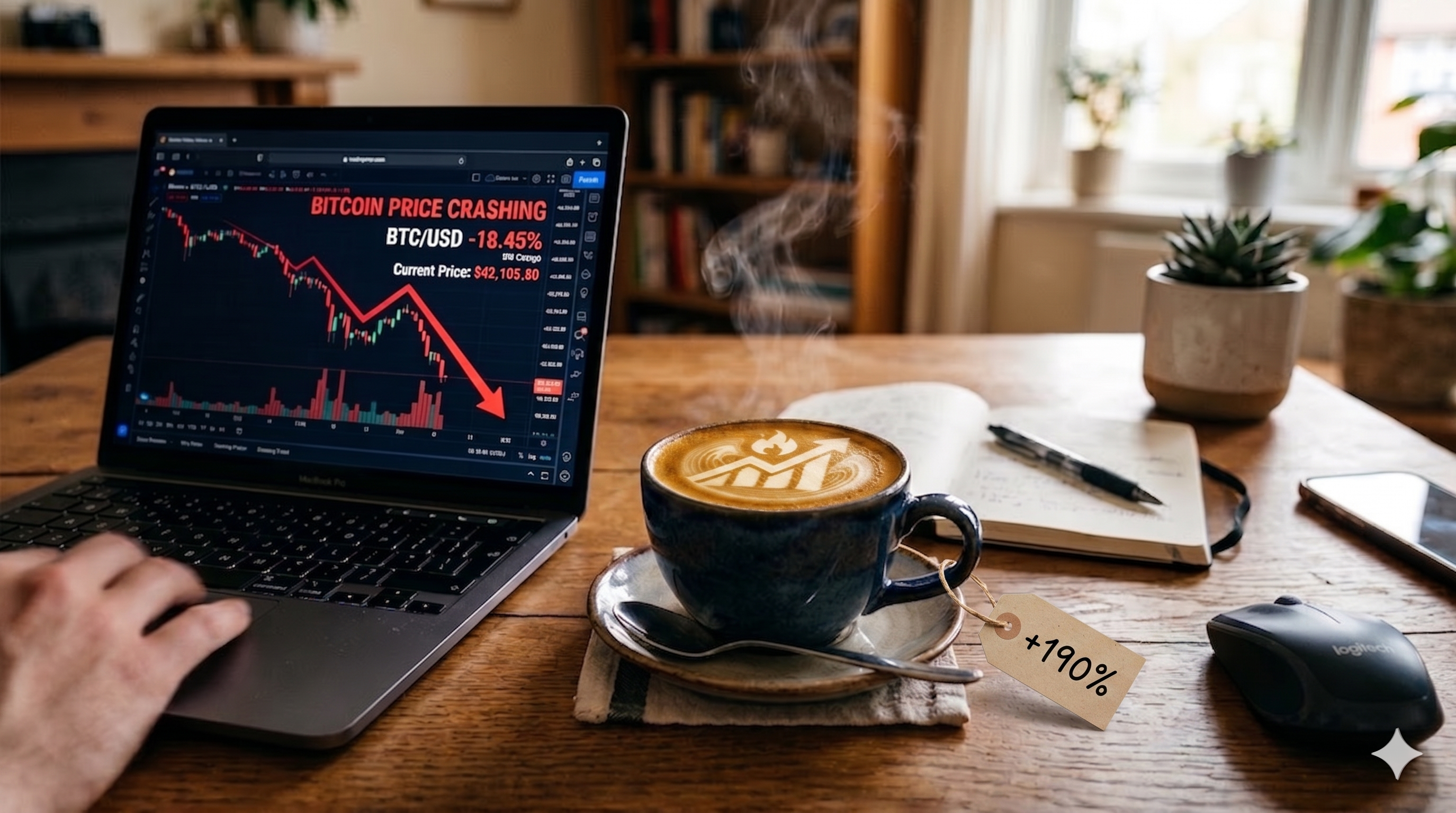
The world is on fire. Portfolios, meanwhile, keep climbing.
It is one of the great cognitive dissonances of our time: while headlines bombard us with images of missiles, sanctions, kidnapped dictators and presidents rage-tweeting at 2 a.m. with the enthusiasm of an angry teenager, stock markets are doing something absolutely scandalous. They are rising. The S&P 500 hit a new all-time high on May 8, 2026, at 7,401 points. Over one year, the flagship U.S. index has gained more than 27%. The Nasdaq crossed the symbolic 24,000-point mark. The patient investor who kept a cool head in January — despite the bombs, the tariffs and the geopolitical circus — is now comfortably sitting on gains that their pessimistic brother-in-law — the one who “moved everything to cash to wait until things calm down” — can barely hide envy over. So what is actually going on?
The 2026 paradox: a hostile world, a serene stock market
Let’s set the scene frankly. Iran closes the Strait of Hormuz. Trump rejects a peace proposal live on Truth Social with the rhetorical subtlety of a tank in a china shop. The war in Ukraine drags into its fourth year. Maduro is behind bars, shaking energy prices and Latin American supply chains. Bitcoin dozes somewhere between $80,000 and general indifference. And U.S. inflation, thought to be tamed, looks at the oil spike as an invitation to return. Oil prices jumped about 3% in a single session last week, as traders reacted to Trump’s rejection of the Iranian proposal — stoking fears of a prolonged conflict and a return of pump-price inflation. And yet. Markets are not correcting. Or at least, not with the violence these headlines would seem to demand. How is that possible? What the informed investor sees — and what the average anxious citizen does not — is that the stock market is not the evening news.
What investors see that you don’t
The market, in its cold cynicism, does not reward headlines. It rewards earnings. And earnings, right now, are extraordinary.
« 88% of S&P 500 companies beat forecasts in Q1 2026 — well above historical averages. In aggregate, results came in 10.8% above estimates. »
Translation: companies are making a lot of money, and they are doing better than analysts expected. In an irrational, chaotic world, they are delivering.
If this pace holds, the S&P 500 will post a sixth consecutive quarter of double-digit earnings growth. Projections for the rest of the year are ambitious: expected growth of 20.1% in the second quarter, 22.2% in the third, and 19.9% in the fourth — or +18% for 2026 as a whole. That is the brutal truth. The institutional investor managing billions of dollars is not watching CNN at 11 p.m. They are watching Alphabet’s cash flows, NVIDIA’s margins, Microsoft Azure’s order books. And what they see there is, for now, reassuring.
AI: the hidden engine of resilience
If you are looking for a culprit behind this irreverent market good humour, look toward artificial intelligence. Despite the deadlock in peace talks with Iran and the persistent closure of the Strait of Hormuz, the AI-related dynamic has continued unabated. Chipmakers are widely outperforming the market: the semiconductor index jumped 2.5% in a single session, suggesting the AI wave shows little sign of fading.
It is fascinating, and a little dizzying. War in the Middle East pushes oil higher, which feeds inflation, which worries the Fed — but NVIDIA, meanwhile, keeps selling chips at full speed to every giant building AI models. These two realities coexist, and the market, in its wisdom or collective blindness, has decided the second outweighs the first.
In three months, share buybacks in the United States reached $500 billion — roughly Belgium’s annual GDP, spent supporting stock prices. When companies themselves become the biggest buyers of their own shares, gravity works differently.
History as an antidote to panic
There is an anecdote I love to tell when anxiety rises. On December 7, 1941, Japan bombs Pearl Harbor. The next day, the New York Stock Exchange opens. And it… rises. Slightly, but it rises. Investors collectively decided that America’s entry into the war would stimulate industrial production. They were right.
History confirms it: in conflicts involving the United States, equity markets have often seen sharp short-term volatility before recovering and posting gains. During the 2003 Iraq War, the S&P 500 gained more than 25% over the first full year after the invasion began. During the 1990–1991 Gulf War, the index first fell 11%, then staged a sharp relief rally.
The stock market is not moral. It does not mourn victims or applaud heroes. It anticipates future profit flows. And in recent history, wars — however terrible in human terms — have often been followed by reconstruction, military orders and massive government spending. All of that is GDP.
The dichotomy between mood and performance
There is a statistic that haunts me. Polls conducted in the United States in 2025 and 2026 show that a majority of Americans believe the U.S. economy is in recession. It is not. The U.S. labour market remains solid, corporate profits are hitting records, and the S&P 500 just set an all-time high. People are convinced they are in misery while their RRSPs and TFSAs quietly grow.
This phenomenon has a name in academic circles: vibeflation — the inflation of negative feelings, disconnected from real data. Social media, TikTok’s anxiety-inducing algorithm and continuous news channels have turned perception into reality for millions of people. Result: a psychological recession in an objectively resilient economy.
The rational investor looks at the numbers. They see that earnings outlooks have been raised, with S&P 500 companies expected to generate more than $605 billion in cumulative profits — above prior estimates — and that AI-related stocks continue to provide additional support even when macroeconomic forecasts darken.
And Bitcoin in all this? The safe haven that fell asleep standing up
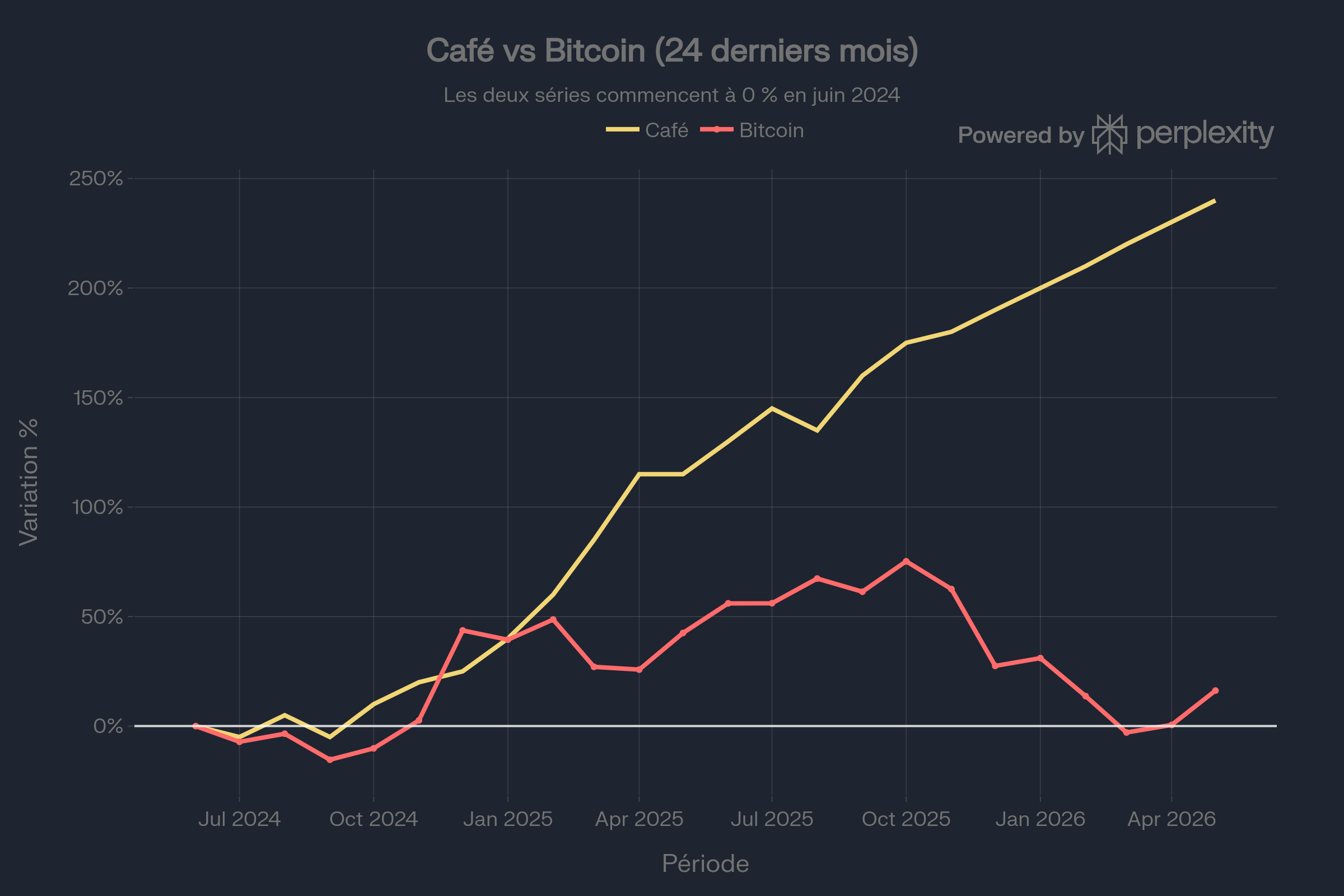
Ah, Bitcoin. The one that was supposed to be the “ultimate safe haven” in times of crisis. Gold 2.0. The bulwark against central-bank madness. The only asset able to cross wars, crashes and geopolitical crises with its head held high.
It is dozing. At about US$80,300 on this May 14, 2026, Bitcoin is down about $23,800 from last year’s level, and nearly 18% lower year to date. While the S&P 500 was smashing records and geopolitics caught fire — exactly the scenario its digital evangelists promised would turn into a rocket — Bitcoin decided to settle on the couch and watch TV.
What that reveals is instructive: in periods of real geopolitical stress, capital does not flee into speculative digital assets. It flees into the U.S. dollar, physical gold and government bonds. Bitcoin has not yet earned safe-haven status. It remains a speculative asset — capricious and juvenile.
A comparison that should make any Bitcoin maximalist blush: since January 2023, Robusta coffee is up +263%. Arabica, +190%. Your morning cup has outperformed the 21st century’s “digital gold.” Puts things in perspective, doesn’t it?
It may be the most delicious — and most stimulating — statistic of 2026. Robusta coffee, that humble roasted bean that ends up in your cup at 6 a.m. before you have even put on your slippers, has returned +263% since January 2023. Arabica, the sophisticated older sibling you order by first name at the café, is up +190% over the same period.
Meanwhile Bitcoin — that revolutionary, decentralized, inflation-proof asset meant to redefine global finance — is down over one year. It has been beaten by a ton of coffee beans. By beans. Beans that pests, Brazilian droughts and late containers were enough to push to new highs, with no blockchain, no wallet, no private key, and less pressure than your favourite cryptobro. You can picture the scene: a crypto hedge-fund manager explaining to investors, face fallen, that no, this year a ton of Robusta outperformed their token portfolio. “But it’s the long term that counts,” they will say. Of course. Brazilian coffee producers are not asking themselves that question.
What this means for you
If you sold your investments in January because you were convinced the Iran war would make everything collapse, here is the uncomfortable truth: the market proved you wrong. This is not an invitation to arrogance or reckless risk. A VIX above 18 points reflects persistent anxiety. Stretched tech valuations, global geopolitical tensions and the burden of U.S. debt are real risks. The U.S. market is walking a ridge line. An unpleasant surprise — a major military escalation, a tech-earnings disappointment, a sudden Fed pivot — could trigger a fast, painful correction.
But here is what history teaches us, again and again: time in the market beats timing the market. Investors who stayed the course in March 2020, at the height of the pandemic, saw their portfolios double in three years. Those who waited for things to “calm down” sometimes waited too long. The stock market in 2026 offers a masterclass on the nature of capitalism: it is resilient, insolent, and deeply indifferent to human drama. It looks ahead. Always ahead. While you watch the news with anxiety, it is already counting next quarter’s profits.
Sources: Euronews — S&P 500 and Nasdaq set new records despite the war with Iran (April 2026) → data on the 7,022 pts, the +11% rebound, historical comparisons (Iraq 2003, Gulf 1991) XTB / FactSet — S&P 500 Q1 2026 results → the 88% positive surprises, 13.2% earnings growth, quarterly projections La Libre / Pictet AM (Christopher Dembik) → $500B of share buybacks in 3 months Boursorama / Reuters → Trump’s rejection of the Iranian proposal, 3% crude spike in one session, Strait of Hormuz closure Fortune.com → daily BTC prices: $80,304 on May 13, 2026, ~$23,808 decline over one year Cafés Le Gascon → Arabica +190%, Robusta +263% since January 2023 Info.fr / Pleine Vie → 500g pack from €6.79 to €10.59 (+37% in 3 years), Carte Noire +46% in one year TradingEconomics → Arabica futures around $2.92/lb in May 2026